Crease is the AI coffee companion in Reveries. It knows your bags, brews and gear, and helps you dial in, compare and learn.
Ask why yesterday's cup was sour and Crease looks at yesterday's cup. Ask what to change on a new bag and it checks what you have already tried. When the question is about coffee itself, it draws on a verified field guide to origins, varietals, processing, roasting, brewing methods and equipment.
Five questions, five different kinds of looking up. Each is one real conversation with a sample journal, with the steps Crease took beside it.
Reads your brew history
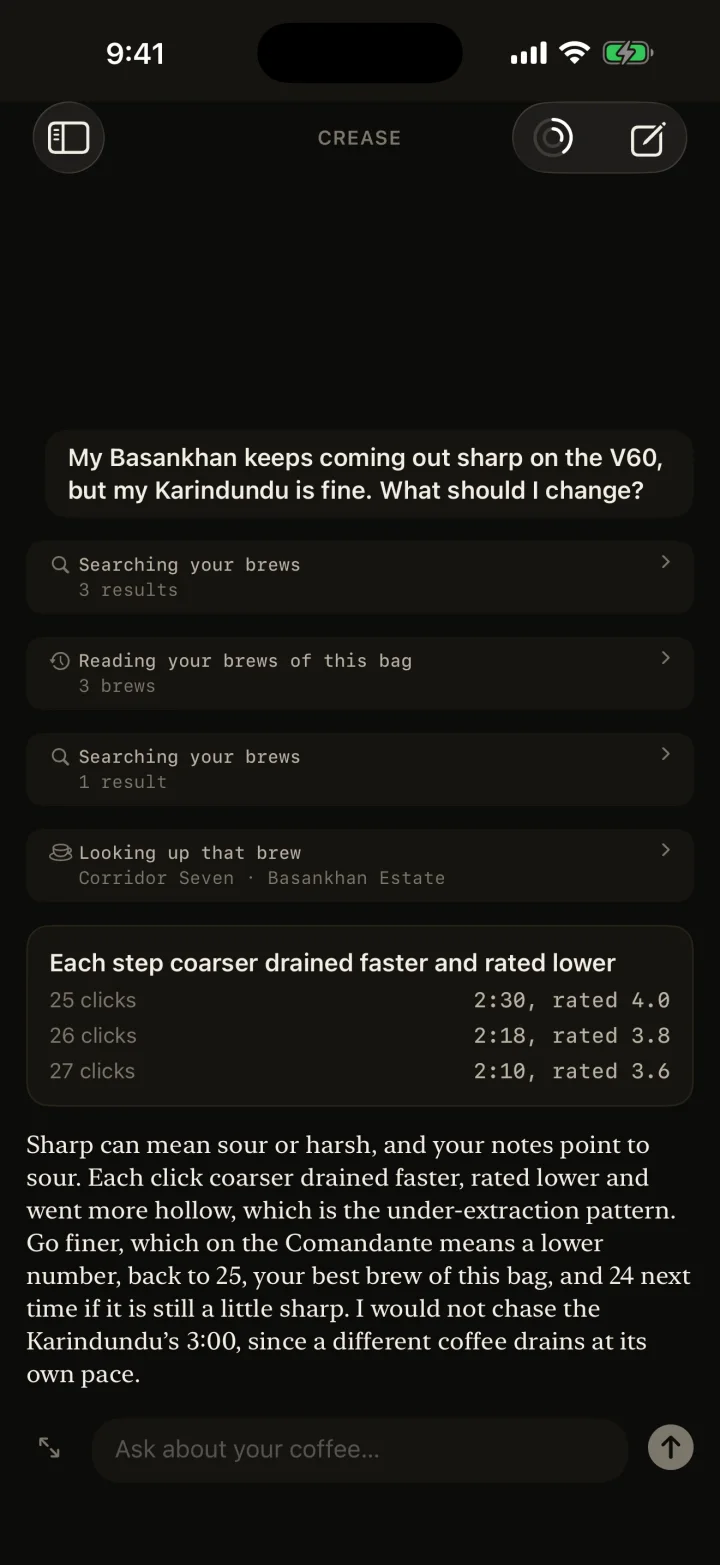
My Basankhan keeps coming out sharp on the V60, but my Karindundu is fine. What should I change?
Searching your brews3 results
Reading your brews of this bag3 brews
Searching your brews1 result
Looking up that brewCorridor Seven · Basankhan Estate
Each step coarser drained faster and rated lower
25 clicks
2:30, rated 4.0
26 clicks
2:18, rated 3.8
27 clicks
2:10, rated 3.6
Sharp can mean sour or harsh, and your notes point to sour. Each click coarser drained faster, rated lower and went more hollow, which is the under-extraction pattern. Go finer, which on the Comandante means a lower number, back to 25, your best brew of this bag, and 24 next time if it is still a little sharp. I would not chase the Karindundu’s 3:00, since a different coffee drains at its own pace.
What Crease did
Searched your pour-over brews for the Basankhan and found 3.
Read every brew of that bag in order, with what changed between one and the next.
Pulled your best-rated V60 of a different coffee, the Karindundu, to compare.
Opened a brew to read its notes.
Put the three Basankhan brews side by side in a card.
Answered from the trend in your own numbers, not a guess.
Compares your own brews of the same bag and points to what changed.
Knows the brewing guides
My V60 drains slowly and tastes sour. I’m at 20 clicks on my Comandante. Finer should fix sour, right?
Consulting the brewing guidePour-over guide
Looking up your equipmentComandante C40
Not in this case. Sour with a slow drawdown usually means the bed is choking, where fines clog the filter and parts of the coffee under-extract while others over-extract, and going finer tends to make that worse. Try one step coarser, which on the Comandante means a higher number, 20 to 21, and pour lower and slower with a gentle swirl. If the drawdown is back to its usual time and it is still sour, the bed was not the whole story, so keep the gentler pour and go finer in small steps.
What Crease did
Read the pour-over guide’s entry for a sour cup.
Looked up the Comandante C40, including which way is finer.
Answered from the guide and the grinder facts, and pushed back on the assumption in the question.
Starts from the guide for your method, and says when the usual fix is the wrong one.
Notices freshness
The bloom on my Anferara went uneven and bubbly yesterday. Is something wrong with the coffee?
Searching your brews1 result
Looking up that brewProud Mary · Anferara
Consulting the brewing guidePour-over guide
Nothing points to a problem with the coffee. That brew was only 3 days off roast, and freshly roasted coffee gives off the most carbon dioxide in its first days, which can stop the grounds wetting evenly at the bloom and open channels. Give the bloom a little longer with a gentle swirl so every ground gets wet, then pour gently. I would leave the grind alone and brew the same recipe again in a few days before changing anything.
What Crease did
Searched your brews for the Anferara and took the most recent one.
Opened that brew, which includes how many days off roast it was.
Read the pour-over guide’s entry for a bubbly bloom.
Answered from the roast date, and changed the pour, not the grind.
Works out how many days off roast a brew was, and what that does to the bloom.
Starts a new bag from what worked
Just opened the Kieni. Where should I start on the V60?
Checking your shelf10 bags on shelf
Searching your brews1 result
Looking up that brewSey Coffee · Karindundu AB
Checking the field guideKenya, Nyeri, SL28
Start where your best V60 of a close cousin landed. The Kieni is a washed Nyeri Kenyan with SL28 and SL34, like your Karindundu, so I would begin at the same recipe: 18 g to 300 g (1:16.7), 94 °C, 22 clicks on the Comandante, and expect a drawdown near 3:00 as a check. Kenyan coffees tend toward bright acidity, so some brightness is the coffee and not a fault. After the first cup change one thing: sour and fast, one click finer, harsh and slow, one click coarser.
What Crease did
Checked your shelf for the Kieni and the bags like it.
Found your best-rated pour-over of the Karindundu.
Opened that brew for its recipe and grind.
Checked the field guide for Kenyan Nyeri coffees and the SL28 varietal.
Answered with a starting recipe borrowed from what already worked for you.
Begins a new bag from the closest coffee you already rated highly.
Speaks your grinder’s language
My worst shot on the Southern Weather ran fast and thin. What was different from my good ones?
Searching your brews1 result
Looking up that brewOnyx Coffee Lab · Southern Weather
Consulting the brewing guideEspresso guide
The logged difference is the grind
Grind
14.3, then 14.6
Shot time
28 s, then 21 s
Dose and yield
18 g in, 36 g out, both
Rating
4.7, then 3.6
Your shot before this one on the bag, rated 4.7, was at 14.3 on the Niche Zero and ran 28 seconds. This one was 14.6 and finished in 21, with the same 18 g in and 36 g out. Your note says sour too, so with a fast, thin shot that reads as under-extraction. Go finer, which on the Niche means a lower number, back to 14.3, and keep dose and yield fixed. Treat the shot time as a check on the grind, not a target.
What Crease did
Searched your espresso shots of that bag, lowest-rated first, and took the worst.
Opened that shot, which includes the previous shot of the bag and what changed.
Read the espresso guide’s entry for a fast shot.
Put the two shots side by side in a card.
Answered with the setting on your Niche Zero, not a generic direction.
Gives finer or coarser, then the number on your own grinder.
In the app
Behind the answers: 757 reference entries citing 683 sources, 31 method guides, 119 brewers and machines, 69 grinders, and your own journal.
What it knows
Your journal, and a coffee field guide.
Your journal
Crease can look up your bags, brews, saved recipes and the coffees you have had away from home. It sees your dose, yield, temperature and timing, your ratings and taste notes, the grinder and brewer you used, and how one brew differed from the last on the same bag. It can also search your past conversations with it. Only you can ask Crease about your journal.
The field guide
Alongside your journal, Crease has a curated reference: coffee origins by country and region, varietals, processing methods, species, grades and defects, roast levels, brewing methods and brewers, and grinders. It is written for Reveries and checked against sources, and Crease says how sure the guide is rather than overstating it.
What you can ask
Questions people actually bring to the bench.
A few of the things you can ask. Phrase them any way you like.
Dialing in a brew
Crease reads the brew you are asking about, its dose, yield, grind, timing and how you rated it, then suggests one change at a time.
Why was my last shot bitter?
Why does my coffee taste sour?
My espresso is running too fast. What do I change?
How do I fix a weak, watery cup?
How do I make my AeroPress less harsh?
Dial in my latest bag.
Your bags, origins and processes
Ask about a coffee you own, or one you are curious about. Answers lean on a verified field guide, and hedge where the evidence is thin.
How should I brew my Ethiopian washed bag?
What should this coffee taste like?
What makes Gesha special?
How does honey processing change the cup?
What is anaerobic fermentation and how does it taste?
What makes robusta different from arabica?
Comparing brews and spotting trends
Because Crease can look through your journal, it can answer questions about you, not just about coffee.
Which bag am I brewing best right now?
Which brew method do I rate highest?
Has my espresso improved this month?
How did I dial in this bag?
What do I usually taste in my best cups?
Which of my bags should I finish first?
Gear and grinders
Name your grinder or machine and Crease uses what the field guide knows about it, including which way is finer, so a suggestion is a real setting and not a guess.
What grind should I try on my grinder for a V60?
Why do fines matter so much for grind quality?
What does pre-infusion do for an espresso shot?
What is channeling and how do I spot it?
How should I prep an espresso puck?
Recipes and methods
Get a starting recipe for a method and a coffee, or learn how a method really works before you buy the brewer.
Teach me pour-over basics.
What should I brew today?
Write me a recipe for the bag I just opened.
How much coffee should I use per cup?
What water temperature should I use?
Learning the vocabulary
The words in a tasting note or a roaster's bag, explained plainly.
What is the difference between extraction and strength?
What do TDS and extraction yield actually tell me?
What is happening chemically during the bloom?
What is degassing, and how many rest days does coffee need?
What do grades like AA or Supremo mean?
Why does the same coffee taste different as it cools?
Your coffee, in the conversation
Ask Crease about this one.
On a bag, a brew or a coffee you had out, tap Ask Crease and that entry travels with your question, so there is nothing to retype. You can also attach a bag, brew or a coffee you had elsewhere to any message. Crease starts from the real details, then offers questions worth asking, such as how to brew a bag, why a brew tasted the way it did, or how to recreate a coffee at home.
Drafts, never surprises
Crease can write entries. You approve them.
Crease can draft changes to your journal, but it never saves anything on its own. Each draft appears as a card showing exactly what would change, and nothing happens until you confirm it.
Log a brew
Describe a cup in your own words, “pour-over this morning, 18 g to 300 g, a bit sour”, and Crease drafts the entry.
Update an entry
Change the rating, notes or favorite on a bag, brew, coffee you had out, or recipe.
Save a recipe
Turn a suggestion, or a brew that worked, into a recipe in your journal.
Honest about its limits
Specific where it can be, careful where it cannot.
Crease says when a number comes from general knowledge and not your journal or the field guide. If it does not know your grinder, it says so and asks. Grind advice is always finer or coarser, translated to your own grinder when the guide knows it. And one change at a time, so you can taste what it did.
Privacy
Your conversations stay yours.
When you ask Crease something, the brew data it needs and your conversation are sent to our AI model provider to write the answer. Nothing is shared with other Reveries users, and your conversations are kept in your account and included in your export. The details are in the privacy policy.
Free and Plus
Free to start, Crease Plus for daily brewing.
Crease is free with a Reveries account, with a monthly allowance. If you brew every day and talk it through often, Crease Plus gives you more Crease for daily brewing, at a founding price while it is new.
Try it
Meet Crease in Reveries.
Reveries is in public beta on iPhone. Leave your email and I will send you the TestFlight link.